
Turnover is one of those things that landlords in DC tend to underestimate until it hits them. A unit sits empty for six weeks. The leasing fees stack up. There is a fresh coat of paint to deal with, a cleaning crew to schedule, maybe a repair that got ignored because the tenant never mentioned it. And then, somewhere in the middle of all that, the question that probably should have come earlier: why did they leave in the first place?
The answer is rarely simple, and it is typically not just about rent. DC rental turnover rates are shaped by a web of factors, some of which landlords can influence directly and some of which are just the nature of the city. Understanding those patterns, and understanding how they shift from neighborhood to neighborhood, is one of the more practical things a DC landlord can do to protect long-term returns.
DC Is a High-Turnover City. But Not Everywhere.
Washington, DC has always had a transient population by design, almost. Government contractors cycle in and out on project timelines. Hill staffers leave when administrations change. Graduate students and young professionals treat the city as a two or three-year chapter before moving on to something else. This creates a baseline churn that landlords in certain neighborhoods simply have to plan around.
But not every part of the city operates this way. That is the part worth paying attention to.
Neighborhoods with strong owner-occupant cultures and longer-established residential identities tend to produce more stable rental tenancies even when the rentals themselves are plentiful. Places like Capitol Hill, Petworth, and Brookland have long attracted tenants who are genuinely trying to put down roots, even if they are renting. They are more likely to stay for multiple lease terms, more likely to renew if the relationship with the landlord is decent, and more likely to treat the unit with some care.
Then there are neighborhoods where the tenant base skews heavily transient. Areas near major universities, near the Hill itself, or close to certain federal employment hubs tend to see higher DC rental turnover rates simply because the people renting there have built-in exit points. That is not a knock on those neighborhoods as investments, it just means the financial model needs to account for more frequent vacancies.
The Reasons Tenants Actually Give
Survey data from property management firms and various tenant satisfaction studies consistently point to a handful of reasons why tenants leave DC rentals. Some of these are predictable. Others are a little more interesting.
Rent increases they were not expecting. This is consistently near the top of the list. Tenants who feel blindsided by a significant rent increase at renewal, especially one that comes with little notice or no explanation, are far more likely to leave than tenants who received advance communication and understood the reasoning. DC has rent control protections covering a substantial portion of the rental stock, but for units that are exempt, abrupt or aggressive increases are one of the fastest ways to lose an otherwise happy tenant.
Maintenance that did not get handled. This one shows up a lot. A tenant might tolerate a slow repair once or twice, but a pattern of deferred maintenance or hard-to-reach landlords tends to erode trust in a way that rent alone cannot recover. By the time a tenant decides to leave over maintenance, the decision has usually been building for months.
Life changes that have nothing to do with the landlord. Job relocations. New partnerships. Having children and needing more space. These are real and common, and they account for a meaningful portion of turnover that landlords cannot prevent. The mistake is assuming that all turnover falls into this category and not examining the parts that are actually controllable.
Neighborhood changes they did not anticipate. This is particularly relevant in DC right now. Gentrification and development patterns have shifted dramatically in certain corridors over the past decade. Long-term renters in some neighborhoods have found themselves priced out not by their own landlord, but by the broader market and the lifestyle changes that come with rapid neighborhood transformation. Noise, construction, changing retail landscapes, and shifting community character all factor into why tenants leave DC rentals in ways that aggregate data tends to miss.
How Neighborhood Type Shapes Retention
It is worth breaking this down more specifically, because the neighborhood context really does shape the retention calculus in meaningful ways.
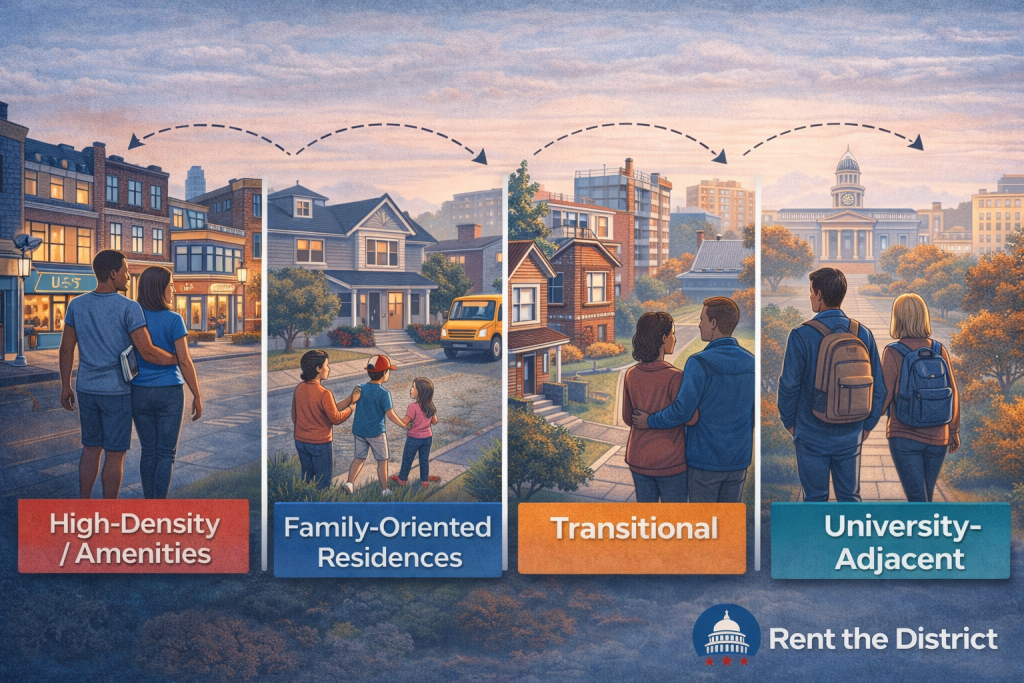
High-density, high-amenity corridors like Logan Circle, U Street, and Shaw tend to attract younger renters who are lifestyle-driven. They are choosing the neighborhood as much as the unit. These tenants often have strong retention in the short term because the neighborhood itself is part of what they are paying for. But they are also mobile. When a comparable unit opens up at a better price point two blocks away, or when they decide to move in with a partner, they go. Washington DC neighborhood rental retention in these areas is relatively good by year one and two, shakier by year three and four.
Family-oriented, residential neighborhoods like Brookland, Takoma, and parts of Ward 4 tend to attract tenants who are actively trying to avoid moving. They have often already done the neighborhood comparison shopping, they may have children in local schools, and they tend to value stability over novelty. Turnover in these areas is lower, but the stakes of a vacancy are also higher because the pool of replacement tenants who fit that profile is narrower.
Transitional neighborhoods are the most variable. Areas that are mid-gentrification, where the housing stock is improving but the services and neighborhood feel are still catching up, can produce unpredictable retention patterns. Some tenants come in as early adopters who plan to stay long-term. Others are opportunistic and leave as soon as a more established area becomes affordable to them.
University-adjacent areas near Georgetown, GWU, American, and Howard operate almost entirely on academic calendars. Turnover is cyclical and predictable, which is its own kind of stability, but it is not the same as actual tenant retention. Landlords here often structure leases around the academic year precisely because the underlying tenant base expects to move.
What Actually Reduces Turnover
This is where things get practical. Because while neighborhood dynamics matter, landlord behavior matters too, and it is the part of the equation that is actually within reach.
Responsive maintenance is probably the single highest-leverage thing a landlord can do to improve Washington DC neighborhood rental retention across almost any property type. Tenants who feel heard when something breaks are meaningfully more likely to renew. This sounds obvious, and it is, but the number of landlords in DC who are losing good tenants over maintenance delays that could have been handled in 48 hours is genuinely high.
Communication around rent increases matters more than landlords typically assume. A tenant who gets a renewal letter with a 7% increase and no context is going to start browsing listings. The same tenant, contacted three months before the lease ends, told that costs have increased, offered a conversation about it, and given a reasonable explanation, is more likely to stay. This is partly about fairness and partly about the psychology of feeling like a person rather than a revenue line.
Knowing your tenant base is also part of this. A young professional in Columbia Heights who has been in the unit for 18 months and mentioned wanting to adopt a dog is a different retention situation than a family in Petworth who has been there for four years and has never been late on rent. Understanding what your tenants actually need, including things like pet policies, is part of proactive retention management, not just a lease clause decision.
Tenant quality from the start affects how this all plays out, too. A tenant who was carefully vetted, who has stable income, who understood the lease terms clearly, and who had realistic expectations about the unit and the neighborhood is simply more likely to become a long-term tenant. Thorough screening at the front end is not just about protecting against nonpayment. It is one of the most underrated tools for reducing turnover over time.
The Real Cost of Getting This Wrong
A single turnover event in a DC rental unit can cost anywhere from one to three months of rent when you factor in vacancy, leasing fees, cleaning, repairs, and the time it takes to get a new qualified tenant signed and moved in. For a landlord with one or two properties, that is a significant hit. For a landlord with a larger portfolio, the cumulative effect of above-average DC rental turnover rates can meaningfully drag down annual returns.
The calculation changes when you look at it that way. Small investments in tenant communication, responsive maintenance systems, and careful screening are not just good landlord ethics. They are financially sensible in a city where the cost of turnover is as high as it is in Washington, DC.
Property Management and the Turnover Problem
This is one of the areas where experienced property managers earn their keep most clearly. Not just in finding tenants, but in building the kind of landlord-tenant relationships that make tenants want to stay.
A good property manager tracks renewal timelines, reaches out proactively before leases expire, flags maintenance issues before they become grievances, and understands the rental dynamics in each specific neighborhood well enough to set expectations correctly. In a city as layered and neighborhood-specific as DC, that local knowledge is not a minor thing.
Landlords who try to manage these relationships at arm’s length, or who treat lease renewal as an administrative event rather than a relationship moment, tend to see higher turnover than those who are engaged. And in the DC market, where vacancy costs are high and qualified tenant demand is still strong in most neighborhoods, that gap in approach tends to show up pretty clearly in the numbers.
A Closing Thought
DC renters leave for a lot of reasons, and some of those reasons are just the nature of the city and the people who come here. But a meaningful portion of turnover is preventable, and the landlords who recognize that tend to perform better over time.
Understanding why tenants leave DC rentals, understanding how that differs across neighborhoods, and being intentional about the things within your control is how you build a rental portfolio in this city that holds its value year after year.
At Rent The District, we think about tenant retention as an active part of property management, not just something that happens on its own. If you are a landlord in DC wondering whether your turnover rate is higher than it should be, or just looking for a more systematic approach to keeping good tenants, we would be glad to talk through what we do and what it might look like for your properties. Reach out and let us show you what retention-focused management actually looks like in practice.
Frequently Asked Questions
Q: What is a normal rental turnover rate in Washington, DC?
A: There is no single benchmark, but in most DC neighborhoods landlords should expect somewhere between 30% and 50% annual turnover across a portfolio, meaning roughly one in three to one in two tenants will not renew in a given year. This varies significantly by neighborhood, unit type, and how the landlord manages the tenant relationship. University-adjacent areas tend to run higher; family-oriented residential neighborhoods tend to run lower.
Q: Which DC neighborhoods tend to have the lowest tenant turnover?
A: Neighborhoods with strong residential character, good schools, and a tenant base that prioritizes stability tend to have lower turnover. Areas like Brookland, Takoma, Petworth, and parts of Capitol Hill consistently produce longer average tenancies compared to high-density, highly transient corridors near universities or major employment hubs.
Q: Can a landlord in DC raise rent to the point where a tenant is forced to leave?
A: For units covered under DC rent control, increases are capped by annual guidelines tied to the Consumer Price Index, with some exceptions for hardship petitions and substantial rehabilitation. For exempt units, landlords have more flexibility, but aggressive rent increases without notice or explanation are one of the leading drivers of preventable turnover. Even where it is legally permitted, a rent increase that pushes out a reliable long-term tenant often costs more in vacancy and re-leasing than it gains in higher monthly rent.
Q: Does offering pet-friendly policies actually help with tenant retention?
A: Consistently, yes. Tenants with pets can face difficulty finding housing in DC, which means a pet-friendly landlord benefits from a more committed, longer-staying tenant pool. Pet owners are often willing to pay monthly pet rent which is extra income to the owner in exchange for the stability, and they tend to stay longer because their options elsewhere are limited.
Q: How does maintenance responsiveness affect tenant retention in DC?
A: It has a surprisingly large effect. Studies and property management experience both point to maintenance handling as one of the top three factors tenants cite when deciding whether to renew. A landlord who responds quickly and communicates clearly about repairs builds the kind of trust that makes tenants stay even when a slightly cheaper unit opens up nearby. Deferred maintenance, or a pattern of being hard to reach, tends to push tenants out even when they otherwise like the unit and the location.