
Vacancy sounds simple. An empty unit. A pause in rent. A temporary gap that will sort itself out. That is usually how it’s framed. And in Washington, DC, that framing misses a lot.
Because vacancy is not just lost rent. It is momentum loss. Pricing pressure. Extra wear. Opportunity cost. Sometimes legal risk. Often stress that shows up later, not immediately.
For owners trying to understand the true cost of vacancy in DC rentals, the surprise is rarely the math itself. It is how many side effects pile up quietly while the unit sits empty.
Some of them are obvious. Others take a while to surface.
Vacancy Rarely Starts When the Unit Goes Empty
This is one of the most misunderstood parts.
Vacancy does not begin the day a tenant moves out. It usually starts earlier, when uncertainty creeps in. Maybe the tenant gives notice late. Maybe the renewal conversation feels awkward. Maybe the unit is priced a little optimistically because the last lease went well.
By the time the unit is officially vacant, the clock has already been ticking.
In DC, where renter demand can shift by neighborhood and season, that timing matters more than owners expect. A missed leasing window can ripple into weeks of downtime, even in areas that feel competitive.
This is why vacancy costs for Washington DC landlords tend to be underestimated. The visible gap is only part of the picture.
Lost Rent Is Just the Surface-Level Cost
Let’s start with the obvious anyway.
If a unit rents for $2,800 and sits vacant for a month, that is $2,800 gone. Everyone understands that. It is easy math.
What is less obvious is how often vacancy extends beyond the initial expectation. A price that feels reasonable may not align with current demand. Showing volume may be lower than expected. Feedback from prospective tenants might be vague or inconsistent.
At that point, owners face a choice. Hold firm and wait. Or adjust and lease faster.
Both options have costs.
Waiting means continued loss. Adjusting often means lowering rent or offering concessions that effectively reduce annual income. Either way, the original pricing assumption stops holding up.
What Vacancy Actually Costs in Washington, DC (With Real Numbers)
It helps to ground all of this in real figures.
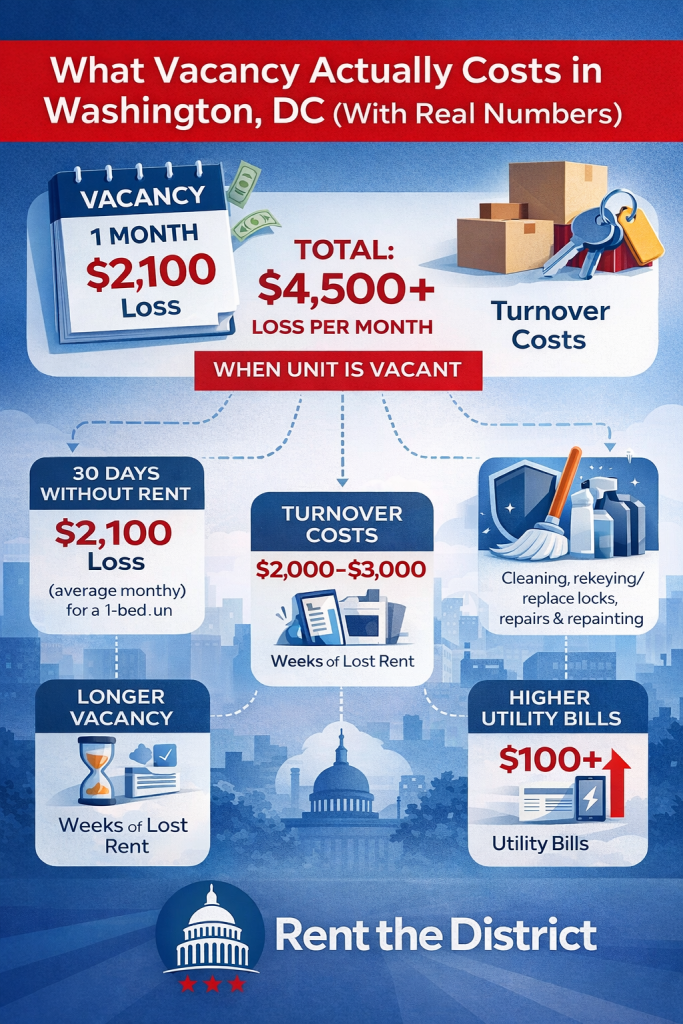
Across Washington, DC, average rents sit in the mid-$2,400s citywide, with one-bedroom units averaging just over $2,100 per month. That means a single vacant month already represents a four-figure loss before anything else is considered.
But rent is only the starting line.
A typical DC turnover brings a familiar list of expenses. Professional move-out cleaning often runs a few hundred dollars. Rekeying or replacing locks adds another line item. Minor repairs, touch-ups, or partial repainting are common, especially in units that have been occupied for more than a year. Even when nothing major is wrong, preparing a unit for the next tenant regularly costs owners between $2,000 and $3,000 once everything is tallied.
Put those together and the picture sharpens.
For a one-bedroom renting at around $2,100 per month, a 30-day vacancy paired with standard turnover costs can easily total $4,500 or more. That is close to one-fifth of the unit’s annual gross rent, gone in a single transition. If vacancy stretches to 60 days, which is not unusual when pricing or timing slips, the combined impact can exceed a quarter of annual rental income.
These are not worst-case scenarios. They are routine outcomes.
Washington, DC’s rental vacancy rate hovers around seven percent, which means vacancy itself is not an anomaly. What surprises many owners is how quickly the financial impact accelerates once time and turnover costs interact. Each additional week compounds losses, not just through missed rent, but through delayed recovery of those fixed turnover expenses.
This is why vacancy feels heavier than it looks on paper.
The numbers rarely show up all at once. They arrive in pieces. A cleaning invoice here. A repaint there. A month without rent that quietly becomes six weeks. By the time owners step back and assess the situation, the cost has already been absorbed.
Understanding these real DC vacancy costs does not eliminate them. But it does change how owners approach pricing, preparation, and timing. And in a market where small missteps can translate into five-figure annual differences, that awareness matters more than most expect.
Turnover Costs Add Up Faster Than Most Owners Realize
Vacancy almost always comes with turnover. Even in well-maintained units.
Cleaning. Touch-ups. Minor repairs that did not matter before suddenly feel urgent. Appliances that worked fine last year now look questionable. A small scuff becomes a repaint. A loose handle becomes a replacement.
None of these are dramatic. That is the problem.
They are incremental. And because they happen between tenants, they are often mentally bundled into vacancy rather than tracked separately.
Over time, this blurs the real financial picture. Owners remember the rent gap, but forget how much it cost to get the unit ready again.
In DC, where tenant expectations are relatively high, skipping these steps is rarely an option. Doing them halfway usually backfires.
Pricing Mistakes Are More Expensive Than They Look
One of the most common causes of prolonged vacancy is mispricing.
Not wildly off. Just slightly.
A rent that is $100 to $150 above market can feel defensible. Especially if the unit leased quickly last time. But markets move. Micro-markets move even faster.
Understanding how DC neighborhoods affect rental pricing is critical here. A unit near Foggy Bottom behaves differently than one near H Street, even if the square footage and finishes are similar. Tenant demand, turnover patterns, and price sensitivity shift block by block.
When pricing is off, vacancy stretches. And stretched vacancy usually forces sharper adjustments later than a small correction would have required upfront.
That is where owners quietly lose leverage.
Vacancy Can Push Owners Into Worse Leasing Windows
Timing matters in DC more than many people expect.
A unit that goes vacant in late spring often leases faster than one that hits the market in late fall. Miss the peak window and demand softens. That softness leads to longer listing times, more negotiation, and sometimes lower-quality applicants.
A one-week delay early in the process can push leasing into a slower period. That is when vacancy starts influencing not just income, but tenant selection.
This is one of the less discussed DC rental vacancy risks. Vacancy does not exist in isolation. It interacts with seasonality.
And seasonality is unforgiving.
Vacancy Affects Tenant Quality, Not Just Cash Flow
Vacancy can quietly influence decision-making, not just the cash flow.
When a unit has been empty longer than expected, pressure builds. For individual, self-managing owners especially, that pressure often shows up as urgency. The listing has been live for weeks. Showings slow down. Carrying costs continue. At that point, even a slightly weaker application can start to look acceptable.
And we are not talking about carelessness. Instead, we are talking about context.
Most single-property owners do not have the benefit of broader market comparisons or consistent screening systems. When vacancy drags on, decisions are made in isolation, often with incomplete information. Small compromises feel practical in the moment, even if they introduce risk later.
Professional property managers operate differently. They are less exposed to that kind of pressure because leasing decisions are grounded in systems, benchmarks, and volume. Standards stay consistent, even when timelines stretch, because the process is not driven by urgency alone.
This distinction matters. Vacancy itself does not lower tenant quality. The way it is managed does.
There Is Also a Mental Cost Nobody Tracks
This is not in a spreadsheet, but it is real.
Vacancy creates background noise. Checking listing platforms. Refreshing inboxes. Wondering if the price is wrong. Debating whether to repaint. Second-guessing decisions.
For owners with one or two properties, this mental load is often heavier than expected. Especially when the rental was supposed to feel passive.
This is often the point where owners start reconsidering their setup. Not because vacancy is catastrophic, but because it is distracting.
Where Property Managers Change the Math

This is not about outsourcing responsibility. It is about changing exposure.
Property managers reduce vacancy costs by compressing timelines. Better pricing strategy upfront. Faster response to inquiries. More consistent showing processes. Clearer feedback loops.
They also tend to see patterns individual owners cannot. Which price points stall. Which neighborhoods turn faster. Which upgrades actually matter to renters right now.
Mentioning property managers here is not about selling services. It is about recognizing that vacancy is partly a systems problem. Systems reduce drag.
In a market like DC, that drag is expensive.
Vacancy Is a Strategy Issue, Not Just a Market Issue
Some owners assume vacancy is unavoidable. And to an extent, it is.
But how long a unit stays empty, and what that emptiness costs, is shaped by preparation. Pricing accuracy. Timing. Communication. Follow-through.
Owners who understand the true cost of vacancy in DC rentals tend to make different decisions. They invest earlier. They adjust faster. They avoid holding out for ideal scenarios that rarely materialize.
That mindset shift often matters more than any single tactic.
A Practical Bottom Line
Vacancy is not just about missing rent. It is about momentum loss, pressure, and secondary costs that stack quietly.
In Washington, DC, those costs add up faster than many owners expect. Especially when pricing, timing, or expectations are slightly misaligned.
Reducing vacancy is rarely about luck. It is about systems, market awareness, and realistic decision-making.
If vacancy has started to feel heavier than it should, we often see owners benefit from a more structured, local approach. We believe thoughtful pricing, timing, and leasing strategy can reduce downtime without sacrificing quality. Exploring how we handle vacancy and leasing at Rent the District might be a helpful next step.
FAQs
How long do DC rentals typically stay vacant?
A: It varies by neighborhood, season, and pricing accuracy. Well-priced units often lease quickly, while mispriced ones can linger.
Is vacancy always a sign of low demand?
A: Not necessarily. Vacancy is often caused by pricing or timing issues rather than lack of renters.
Does vacancy affect tenant quality?
A: Yes. Longer vacancies can pressure owners into rushed leasing decisions, increasing future risk.
Are vacancy costs tax deductible?
A: Some turnover and marketing expenses may be deductible, but lost rent generally is not.
Can property managers really reduce vacancy?
A: They often help by improving pricing accuracy, response times, and leasing systems, which shortens downtime.