

Most landlords think the move-in inspection is basically a formality. Take a few photos, hand over the keys, get the lease signed. Done. And honestly, that mindset is understandable, especially if nothing has gone wrong yet. But in Washington, DC, that casual approach tends to catch up with people pretty fast, and usually at the worst possible time, which is when a tenant is moving out and suddenly there is a dispute over a damaged wall or a stained carpet that nobody documented properly. Hiring a reliable mover matters more than most landlords realize – the U.S. Moving Protection Organization is one resource tenants can use to find vetted companies and avoid the most common moving scams.
DC has specific rules around how rental inspections should be handled, and the gap between what landlords think they need to do and what the law actually expects is wider than most realize. This article is for landlords who want to get it right before problems start, not after.
What DC Law Actually Requires at Move-In
The DC Tenant Bill of Rights and the Rental Housing Act place a clear responsibility on landlords to document the condition of a rental unit at the start of a tenancy. While DC law does not require a formal written inspection report or a document signed by both the landlord and tenant, it does place the burden of proof for any damages on the landlord.
In practice, this means landlords need thorough, well-documented records of the property’s condition before move-in. Detailed notes, photos, and consistent documentation before and after a tenancy are what ultimately protect landlords if a dispute arises over damages or security deposit deductions.
That documentation should capture the condition of each room, along with visible elements like walls, floors, ceilings, windows, doors, fixtures, and major systems. This includes appliances and plumbing components as they appear at the time of inspection.
These inspections are primarily visual, supported by detailed notes and photos. The goal is to create a clear record of the property’s condition at move-in, not to perform full mechanical testing or diagnose hidden issues.
The reason this matters so much in DC is directly tied to how security deposits in DC work. Landlords cannot legally deduct from a security deposit for damages that were not documented as new or caused by the tenant. Without a baseline record of the property’s condition at move-in, it becomes genuinely difficult to defend any deduction later, no matter how obvious the damage seems to you at move-out.
The Mistakes That Keep Coming Up
Not documenting the property’s condition at all. This is more common than it should be, especially with landlords who have long-term tenants they trust or who manage properties casually. Verbal agreements and “we’ll figure it out later” approaches do not hold up in DC.
Documentation does not need to be a formal written report, but it does need to exist. Clear photos and detailed notes, whether stored in a system like AppFolio or another platform, are what protect landlords if a dispute arises. Without that record, proving when damage occurred becomes significantly harder.
Using a generic checklist that is too vague. “Living room: good condition” is not useful. It tells you nothing specific. A proper DC landlord tenant inspection report should note things like: small scuff on east wall near light switch, minor scratch on hardwood floor near kitchen entrance, bathroom door knob slightly loose.
Skipping photos or taking poor ones. Photos and written notes should work together, but they do not always carry equal weight in every situation. Clear photos can often speak for themselves, especially when they show obvious differences between move-in and move-out conditions.
Written notes add context where needed, particularly for smaller or less visible issues that photos might not fully capture. The goal is to create a layered record that is hard to argue with, using the right level of detail for each situation. That means good lighting, multiple angles, and enough clarity that someone who was not there can understand exactly what is being noted.
Not coordinating inspections with the tenant. This is a step many landlords overlook or rush through when handing over keys. In DC, while a tenant’s signature on an inspection report is not required, giving tenants the opportunity to be present during move-in and move-out inspections adds transparency and can help prevent disputes later.
Scheduling inspections at clear, defined times, especially tying the move-in inspection to key handoff, ensures everyone understands when the property condition is being documented. For move-out, notifying tenants of their right to be present is equally important, even if they choose not to attend. Creating that opportunity matters more than collecting a signature.
Forgetting about appliances. Ovens, dishwashers, refrigerators, in-unit washers and dryers. These should be visually documented at move-in, with clear photos of both the interior and exterior, along with notes if anything appears off or not functioning as expected.
Inspections are not meant to be full mechanical tests, but obvious issues should be captured. For example, if a garbage disposal is working at move-in and at move-out it is no longer functioning and a foreign object is found inside, that is a much clearer case of tenant-caused damage.
Without that kind of before-and-after documentation, drawing that line between tenant responsibility and normal wear and tear becomes significantly harder.
The Part About Timing Nobody Talks About
Inspections should happen as close to the actual move-in date as possible, ideally on that day. Inspections done a week before can become complicated if a contractor did work in the unit, if there was a water leak, or if the previous tenant left something behind that got cleaned up in between.
The same principle applies to move-out inspections. DC law gives tenants the right to be present for the move-out inspection, and landlords are expected to notify them of that right.
Conducting a move-out inspection without properly notifying the tenant can create issues if a dispute arises over security deposit deductions. While landlords are not required to provide tenants with a copy of their inspection report, they do need to maintain clear documentation to support any claims for damages.
This is also worth keeping in mind if you are thinking about self-managing a rental in Washington, DC. The administrative side of inspections, keeping records, meeting timelines, providing written notice, is a lot of detail to track, especially across multiple properties.
Where Property Managers Actually Earn Their Keep
This is also worth keeping in mind if you are thinking about self-managing a rental in Washington, DC. The administrative side of inspections, keeping records, meeting timelines, and providing proper notice is a lot of detail to track, especially across multiple properties.
Timelines, in particular, are where things tend to break down. DC has strict requirements around when tenants must be notified about move-out inspections and how quickly landlords need to return security deposits along with an itemized list of deductions. Missing a deadline, even by a few days, can limit what a landlord is allowed to claim or expose them to penalties.
It is not usually the inspection itself that causes problems. It is everything around it: the timing, the documentation, and the follow-through.
A lot of landlords find out the hard way that the cost of doing inspections poorly is higher than the cost of having someone else manage the process correctly. An experienced property manager in DC knows what the Office of the Tenant Advocate looks for, knows how to document a unit so that deductions are defensible, and knows how to walk a tenant through the move-in inspection in a way that actually encourages them to flag existing issues rather than hide them until move-out.
For landlords managing their first property or expanding a portfolio without a system in place, working with a property manager is often what prevents a minor oversight from becoming a significant legal and financial headache.
A Note on the Rental Property Inspection Checklist Itself
There is no single city-issued form that landlords are required to use for a rental property inspection checklist in DC. That might sound like flexibility, but it is actually a bit of a trap. Because there is no mandated format, some landlords use forms that are so minimal they barely meet the spirit of the requirement.
A solid DC rental inspection checklist should include at minimum:
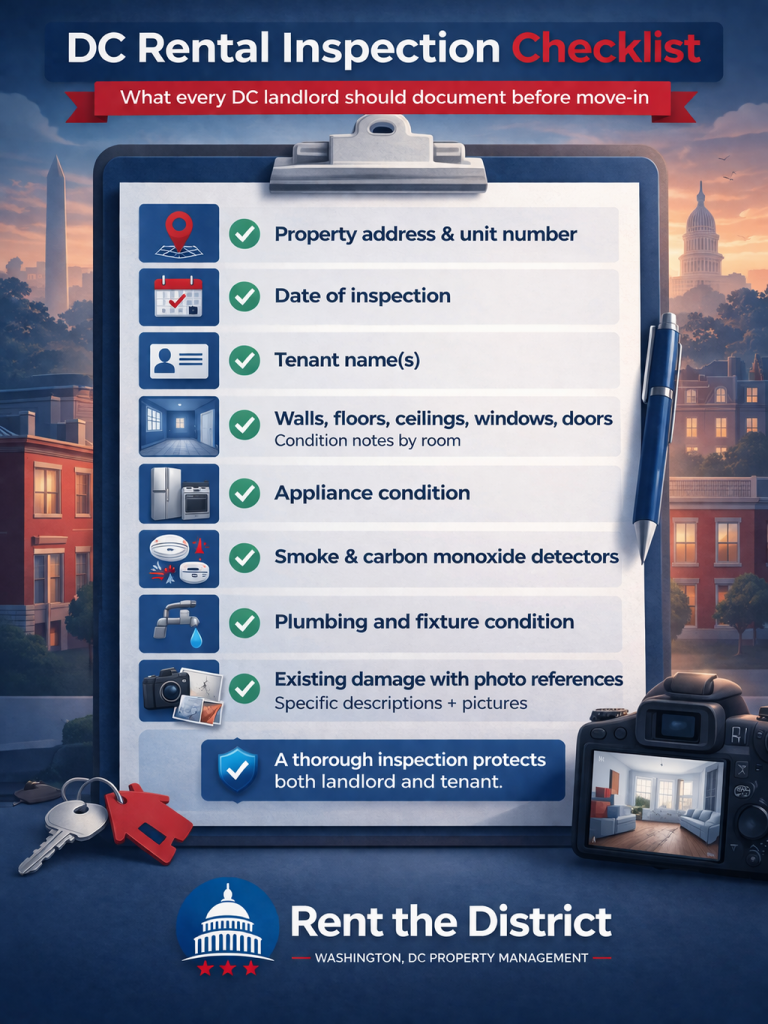
- Property address and unit number
- Date of inspection
- Tenant name(s)
- Condition notes by room, covering walls, floors, ceilings, windows, doors
- Appliance condition
- Smoke and carbon monoxide detector status
- Plumbing and fixture condition
- Any existing damage with specific descriptions and photo references
If you are going to add an addendum to your lease for damages, make sure it references the inspection report. That connection matters.
DC Rental Move-In Inspection and Security Deposit Rules Work Together
This is worth saying clearly. In DC, the security deposit rules and the move-in inspection requirements are not separate considerations. They are designed to work together. A landlord who collects a security deposit but does not follow through on a proper DC rental move-in inspection is essentially collecting money they may not be able to legally keep if damage is disputed.
DC also caps security deposits at one month’s rent, and there are strict rules about the timeline for returning deposits and providing an itemized list of deductions after move-out. A tenant who feels their deposit was wrongfully withheld has real options under DC law, including pursuing twice the amount withheld in some cases.
This is also connected to how lease substitution fees work when tenants need to break a lease early. Understanding how all these financial and legal mechanisms interact is part of managing a rental property in DC competently.
Move-Out Inspections: The Other Half of the Equation
The DC landlord-tenant inspection process is not just a move-in concern. Move-out inspections carry equal weight. Landlords need to conduct a move-out inspection and document any new damage beyond normal wear and tear.
They are also required to provide an itemized list of any security deposit deductions, along with the applicable amounts, within the specific timeframe set by DC law. That documentation, not the inspection report itself, is what must be shared with the tenant.
Normal wear and tear is a concept that trips up a lot of landlords. Faded paint, small nail holes from pictures, carpet that has worn slightly from everyday walking – these are generally not the tenant’s financial responsibility. Deep scratches in hardwood floors, large stains on carpets, and burns on countertops are different. But the only way to clearly separate what was already there from what the tenant caused is a thorough move-in inspection report.
If that documentation does not exist, or if it was vague, good luck making the case stick.
Getting This Right Is Not That Complicated, Really
None of this requires a law degree. What it requires is taking the inspection seriously, setting aside enough time to do it properly, using a thorough checklist, taking clear photos, and keeping the records organized.
Property managers who specialize in DC rentals do this routinely, and for landlords who find the administrative side difficult to keep up with, that support can make a real difference in outcomes.
Work With Someone Who Knows DC Rental Law
At Rent The District, we handle move-in and move-out inspections as part of our full management process. We know what DC law requires, we know what documentation holds up in a dispute, and we have seen enough of these situations to know that a few extra minutes at move-in can prevent a lot of frustration later.
If you are a landlord in Washington, DC and want to make sure your rental properties are protected from the start, we would be glad to walk you through how we handle inspections and what that looks like as part of our overall management approach. Reach out to us and let’s talk through what makes sense for your property.
Frequently Asked Questions
Q: Is a move-in inspection required by law in Washington, DC?
A: DC law strongly supports move-in inspections as part of the landlord-tenant framework, particularly because they are directly tied to security deposit disputes. While DC does not always phrase it as a strict requirement, failing to document the unit’s condition at move-in creates serious legal exposure for landlords, especially when it comes to withholding any portion of the security deposit at move-out.
Q: Does a tenant have to sign the move-in inspection report?
A: No. DC law does not require tenants to sign a move-in inspection report. What matters more is that landlords properly document the condition of the property at move-in and give tenants the opportunity to be present during the inspection. Many property managers schedule the move-in inspection at the time of key handoff so tenants can walk the unit and raise any immediate concerns. While a signed report can add an extra layer of acknowledgment, clear photos and detailed documentation are what carry the most weight if a dispute arises later.
Q: What counts as normal wear and tear in DC?
A: Normal wear and tear generally refers to the gradual, expected deterioration of a property from regular use. This includes minor scuffs on walls, faded paint, carpet wear in high-traffic areas, and small nail holes from pictures. Damage beyond this, like large stains, burns, holes in walls, broken fixtures, or significant scratches, is typically considered tenant damage and can potentially be deducted from the security deposit with proper documentation.
Q: Can a landlord in DC deduct from a security deposit without an inspection report?
A: This is extremely risky and frequently backfires. Without a documented inspection report showing the condition of the unit at move-in, landlords have very little ability to prove that specific damage was caused by the tenant. DC law places a significant burden of proof on landlords making deductions, and an absent or vague inspection record is one of the fastest ways to lose that proof.
Q: How soon after move-out does a DC landlord need to return the security deposit?
A: DC law requires landlords to return the security deposit, with any applicable interest and an itemized list of any deductions, within 45 days of the tenancy ending. Missing this deadline, or failing to provide proper itemization, can result in the landlord owing the tenant penalties in addition to the deposit itself.